Copy-ready prompt guide
Wedding AI prompts that produce clearer venue and decor ideas
A useful wedding prompt describes the look you want without asking the AI to replace the venue itself. Use the formulas and examples below as starting points, then change one detail at a time until the concept feels like your wedding.
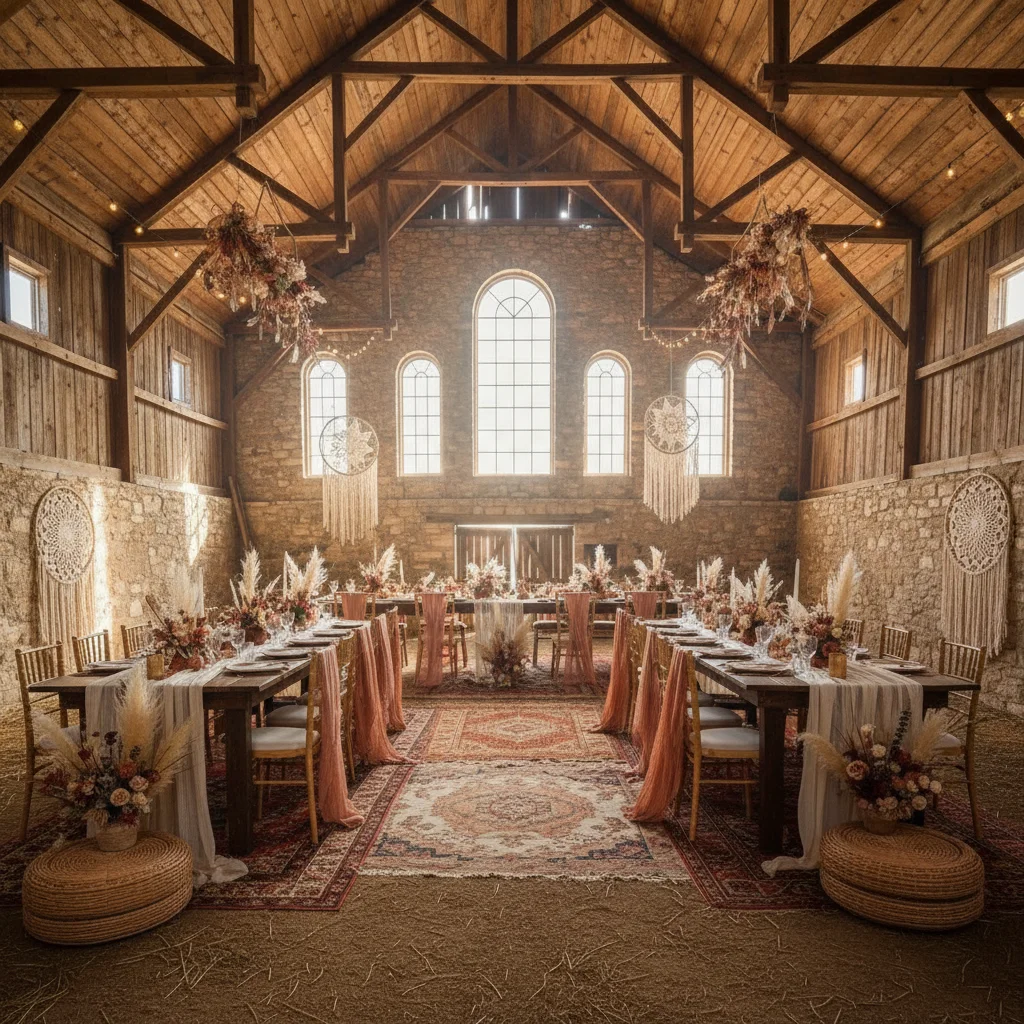
What to do first
- Name the venue area first: ceremony aisle, reception tables, dance floor, or sweetheart table.
- Describe one mood, two main colors, specific decor, and a lighting condition.
- Say which architecture and camera angle should remain unchanged.
- Refine one element per prompt so you can tell what improved the result.
Copy-ready examples
Copy a prompt, then make it yours
Start with the closest example, replace the colors and decor, then upload a photo of the ceremony or reception space you actually plan to use.
Garden ceremony
Transform this lawn into a relaxed garden wedding ceremony with soft white and pale blue flowers, natural wood chairs, low meadow-style aisle flowers, and a loose floral arch. Keep the trees, lawn shape, aisle width, and camera angle unchanged. Use soft late-afternoon light.
Sage green reception
Transform this room into an elegant sage green and warm white reception with round tables, soft sage linens, white flowers, airy greenery, and warm overhead lights. Keep the existing windows, ceiling, floor plan, and dance floor position recognizable.
Candlelit dinner
Style this reception with long tables, ivory linens, low white flowers, clear glassware, and abundant warm taper candles. Keep centerpieces below eye level and preserve the room layout, architecture, and camera angle. Show a realistic evening atmosphere.
Controlled color test
Keep this venue, layout, flowers, furniture, architecture, and camera angle exactly the same. Change only the color palette to sage green, warm white, and natural wood through linens, stationery, and small table details.
A simple wedding AI prompt formula
Start with the photo, then describe the event area, mood, palette, main materials, focal decor, and light. Finish with what should stay recognizable. This gives the generator both creative direction and boundaries.
Template: Transform this photo of my [venue area] into a [mood] wedding in [main color] and [secondary color], with [flowers or materials], [focal feature], and [lighting]. Keep the room architecture, windows, ceiling, floor plan, and camera angle recognizable. Make the result photorealistic and achievable as wedding inspiration.
Ceremony prompt examples
Ceremony prompts work best when you describe the aisle, altar focal point, seating edge, and light. Avoid filling every surface; the couple and ceremony should still have visual space.
- Garden ceremony: Transform this lawn into a relaxed garden wedding ceremony with soft white and pale blue flowers, natural wood chairs, low meadow-style aisle flowers, and a loose floral arch. Keep the trees, lawn shape, and camera angle unchanged. Use soft late-afternoon light.
- Modern indoor ceremony: Style this indoor ceremony room in warm white and muted olive with clean-lined chairs, two asymmetric floral arrangements at the altar, and clusters of pillar candles. Keep the walls, windows, ceiling, and aisle width recognizable.
- Rustic barn ceremony: Create a romantic barn ceremony with cream fabric, seasonal greenery, white flowers, wooden chairs, and warm string lights. Preserve the beams, doors, floor, and original proportions of the barn.
- Minimal ceremony: Design a minimal ceremony using ivory, stone, and a small amount of greenery. Add one sculptural altar arrangement and a clear aisle with no extra signs or decorative clutter. Keep the venue architecture unchanged.
Reception prompt examples
For receptions, include table shape, linen, centerpiece height, place setting mood, and overhead or ambient lighting. If you do not want the AI to invent a different room, explicitly preserve the walls, windows, beams, and floor.
- Candlelit dinner: Style this reception with long tables, ivory linens, low white flowers, clear glassware, and abundant warm taper candles. Keep centerpieces below eye level and preserve the room layout and architecture. Show a realistic evening atmosphere.
- Sage green reception: Transform this room into an elegant sage green and warm white reception with round tables, soft sage linens, white flowers, airy greenery, and warm overhead lights. Keep the existing windows, ceiling, and dance floor position.
- Editorial black tie: Create a black-tie reception in black, ivory, and brushed silver with crisp linens, sculptural white flowers, slim candles, and focused table lighting. Keep the original room and camera angle recognizable; avoid adding ornate architecture.
- Colorful summer dinner: Style this venue with coral, butter yellow, and soft pink flowers, mixed bud vases, natural linens, and playful paper details. Keep the furniture layout practical and preserve the venue surfaces.
Prompts for testing a wedding color palette
When color is the question, keep everything else modest. Ask the AI to distribute colors across linens, flowers, stationery, and small accents rather than tinting the entire room. Compare the same venue and layout with different palettes.
- Apply a sage green, warm white, and natural wood palette through linens, foliage, stationery, and small table details. Keep the walls, floor, and existing venue colors unchanged.
- Test burgundy and dusty rose with cream as the main neutral. Use the darker color sparingly in flowers, napkins, and candles, not across the entire room.
- Create a coastal palette using muted blue, sand, white, and clear glass. Keep the decor refined and avoid literal shells, anchors, or themed props.
- Show a warm autumn palette of rust, ochre, cream, and deep green using seasonal flowers, napkins, and candles while preserving the natural colors of the venue.
Prompts for changing one decor decision
Once you like the overall direction, isolate the next decision. Keep the image and most of the prompt the same, then ask for one controlled change. These small comparisons are much easier to discuss with a partner or vendor.
- Keep the entire design the same, but replace tall centerpieces with low, loose arrangements that allow guests to see across the table.
- Keep the palette, flowers, and layout unchanged, but show warmer candlelight and less overhead lighting.
- Keep the reception design unchanged, but remove the ceiling installation and move the visual focus to the tables.
- Keep the ceremony setup unchanged, but reduce the aisle flowers by half and concentrate them near the front.
- Keep the room and decor unchanged, but replace white linens with natural oatmeal linen.
Negative instructions that protect the venue
Negative instructions tell the generator what not to invent. They are especially useful when the real room has distinctive architecture or when you need a concept that remains physically plausible.
- Do not change the windows, walls, beams, doors, ceiling height, or floor material.
- Do not add a staircase, fireplace, balcony, ocean view, or architectural feature that is not in the source photo.
- Do not block exits, doors, or the main guest walkway with decor.
- Do not add text, logos, signs, people, or watermarks.
- Do not overcrowd the room; keep the layout open and believable.
How to improve a prompt that missed the mark
If the result looks generic, add one or two concrete materials or floral qualities. If it looks chaotic, reduce the number of themes and colors. If the venue changed too much, strengthen the preservation instruction and simplify the decor request. If the image feels unrealistic, remove dramatic features and ask for an achievable level of styling.
Keep a copy of the prompt that created your best version. When you refine it, change only one sentence. Prompting becomes useful when it helps you compare decisions, not when every result is based on a completely different request.
Frequently asked questions
What should I include in a wedding AI prompt?
Include the venue area, desired mood, two main colors, flowers or materials, one focal feature, and lighting. Also state which architectural elements and camera angle should remain unchanged.
Why does AI keep changing my wedding venue?
The prompt may focus only on the new style. Add a clear instruction to preserve the walls, windows, ceiling, floor, layout, and camera angle. It also helps to request fewer decor changes in each generation.
Can I copy these wedding prompts directly?
Yes. Replace the venue area, colors, flowers, focal feature, and lighting with your preferences. The examples are starting points designed to work with a real venue photo.